
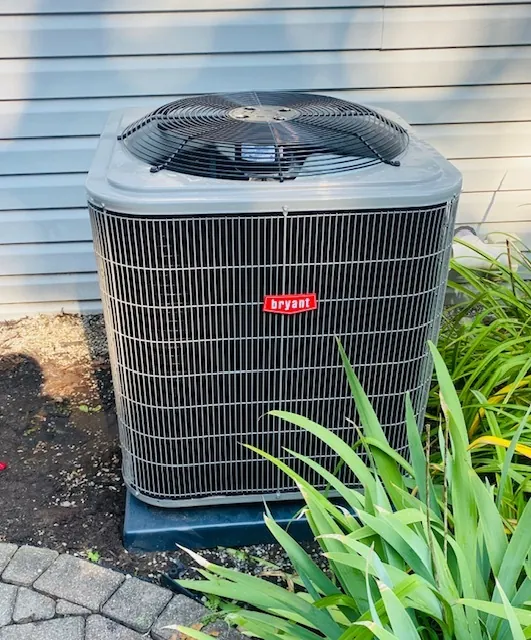
Maybe you’ve seen it on social media — someone running a window AC unit inside a room, supposedly as a cheap way to beat the heat. Maybe a room in your own home stays stubbornly warm and you’re wondering if it’s worth a try. It’s an understandable question, and it has a clear answer: no. A window AC unit can’t cool a room from inside the room, and running one that way can actually make things worse.
At Macklin Heating and Cooling, we get asked about window units and cooling workarounds all across Genesee County and surrounding communities. Here’s the science of why indoor window AC use doesn’t work — and what actually will cool that stubborn room.
Can a Window AC Unit Be Used Inside the House?
Physically, you can plug one in anywhere there’s an outlet. Functionally, it won’t do what you’re hoping. A window air conditioner is designed to work with its back half outside for a reason: cooling requires dumping heat somewhere, and that somewhere is outdoors.
Here’s the problem in one sentence: a window AC unit doesn’t destroy heat — it picks heat up from your indoor air and pushes it out the back. When the whole unit sits inside your room, it picks heat up from the front and dumps it straight back into the same room. Every bit of heat it removes from the air in front of it, it adds back out the rear. Net result: zero cooling — actually worse than zero, as you’ll see next.
What Happens If You Use a Window AC Inside?
Three things, none of them good:
- The room gets hotter, not cooler. The heat removed from the front exhausts out the back into the same space. But the unit also adds its own waste heat — the motor and compressor generate heat as they run. So the net effect is the room warming up slightly, slowly.
- Humidity has nowhere to go. The moisture your AC pulls from the air drips out the back of the unit — normally outside. Indoors, that water pools on your floor or furniture.
- Condensation and electrical risk. Water draining where it shouldn’t, near a powered appliance, is a genuinely bad combination — especially on carpet or wood flooring.
Anyone showing an indoor window unit “working” on social media either has the unit vented through a hose out a window — which makes it, functionally, a portable AC — or the video ends before the room warms up.
Does a Window AC Unit Have to Be in a Window?
A window unit needs its back half exposed to outdoor air — that’s its whole design. The alternative that achieves the same thing properly is a portable air conditioner, which is built with a vent hose you run through a window, wall, or dryer vent opening. The hose carries the hot exhaust outside, which is the job the window was doing for the window unit.
If you’re in a situation where a window unit can’t work — a basement with no suitable window, a room with casement windows, a rental with restrictions — a portable AC or a properly vented through-the-wall unit is the correct answer, not an unvented window unit.
Will a Window AC Help With Central Air?
Sometimes, and it’s a reasonable question. If one room of your home consistently runs warmer than the rest — a west-facing bedroom, a room over the garage, a finished attic — a window unit can supplement your central air in that specific space. Used this way, the window unit exhausts outdoors like it’s supposed to, and your central system doesn’t have to fight the losing battle of cooling your hottest room to the same temperature as everywhere else.
The catch: running two systems at once costs more than running one, and it can create pressure imbalances that backfire if doors and vents aren’t managed sensibly. If one room is always the problem, the better long-term fixes are improving airflow to that room, adding a ductless mini-split for the zone, or addressing insulation and sun exposure. A window unit is a reasonable band-aid; it just isn’t the cure.
Do Window Units Use More Electricity Than Central Air?
Per room, window units often win — cooling one room with a window unit typically uses less electricity than running a whole central system to cool the entire house for that one room. But whole-home is a different story: several window units running in multiple rooms usually cost more to operate than an efficient central system, and they cool less evenly, noisier, and with much less dehumidification than central equipment handles.
Michigan’s humid summers are where window units fall short most noticeably. Central AC wrings serious moisture out of the air; window units do a weaker job, so the room can feel clammy even when the temperature drops.
Is Central Air Better Than Window Units?
For most Michigan homes, yes — for comfort, air quality, noise, and often total energy cost. Central air cools evenly, dehumidifies properly, filters the air, and runs quietly out of sight. Window units make sense for single rooms, apartments, and homes without ductwork — they’re a legitimate tool, just a limited one.
And if your home lacks ducts and you want real whole-home comfort without window units, ductless mini-splits deliver efficient cooling and heating, zone by zone, without any ductwork at all. They’re the modern answer to the problem window units have been patching for decades. See how they work on our mini-split installation page.
FAQ
Can I use a window AC in a room with no windows?
Not effectively. Without venting the hot exhaust outdoors, the unit can’t cool — it just moves heat around the room and adds its own waste heat. A portable AC with a vent hose routed through a wall or ceiling opening is the workable alternative.
Why does my window AC drip water inside?
It’s either tilted the wrong way (the back should angle slightly downward so condensation drains outside) or it’s installed somewhere it can’t drain outdoors at all — which is exactly what happens when a unit runs indoors.
Can I put a window AC through a wall instead of a window?
Yes — that’s called a through-the-wall unit, and they’re built for exactly that. Don’t use a standard window unit in a wall sleeve, though; the venting design differs and performance suffers.
What’s the best way to cool a single hot room?
A properly installed window unit or portable AC works for a quick fix. For a permanent solution — especially in homes without ductwork — a ductless mini-split is quieter, more efficient, and handles the room year-round, heating included.
Need help?
A window AC running inside a room is a machine working against itself — it dumps every bit of heat it removes right back into the same space, plus its own waste heat, plus a puddle of condensate. It can’t work, it won’t work, and it’s not worth the experiment. Vent it outdoors, use a portable AC with a proper vent hose, or for a lasting fix, explore what a mini-split could do for that stubborn room.
If you’ve got a room your current setup can’t tame, Macklin Heating and Cooling can help you find a real solution. As a family-owned company serving Genesee County and surrounding communities since 2010, we’ll point you toward what actually works for your home — not just what sells.
Call us or Request service online — we’re happy to help.
Need heating or cooling service?
Request service online or call our team for installation, repair, and maintenance.
Request service